
How to Search Criminal Dockets
Most people begin with Search ARCourts, the public replacement for CourtConnect. It searches by participant or case number. The number from a court notice works best. Names alone can pull up several people. Keep every punctuation mark intact, because the system reads the string exactly as typed. With only a name, type the first and last names in their own boxes, then use the advanced controls to pick Miller County and the correct court location before you run the Miller County docket search.
Remember that the result is an index, not a certified criminal record. Check the court, case type, filing date, and participant role before opening the events. Then follow this sequence:
- Choose the case-number path when the full court number is available.
- Otherwise search the participant, then narrow the county, court, and date fields.
- Open the matching case and read all public Events in date order.
- Check Offenses, Sentences, settings, later resets, and the displayed disposition.
- Ask the correct clerk for any missing document or authenticated copy.
Miller County Criminal Docket Routes
Searches often fail because the wrong court level was picked. In Miller County, felony prosecutions belong to Circuit Court. The Miller County Circuit Clerk keeps those files. Misdemeanors, ordinance violations, and preliminary felony events may sit on a District Court docket instead. Early lower-court work may not carry the later Circuit Court case number. So one matter can leave traces at two levels.
The official Arkansas circuit judge directory lists the Eighth Judicial Circuit South divisions serving the county. It also shows the court structure behind that split.
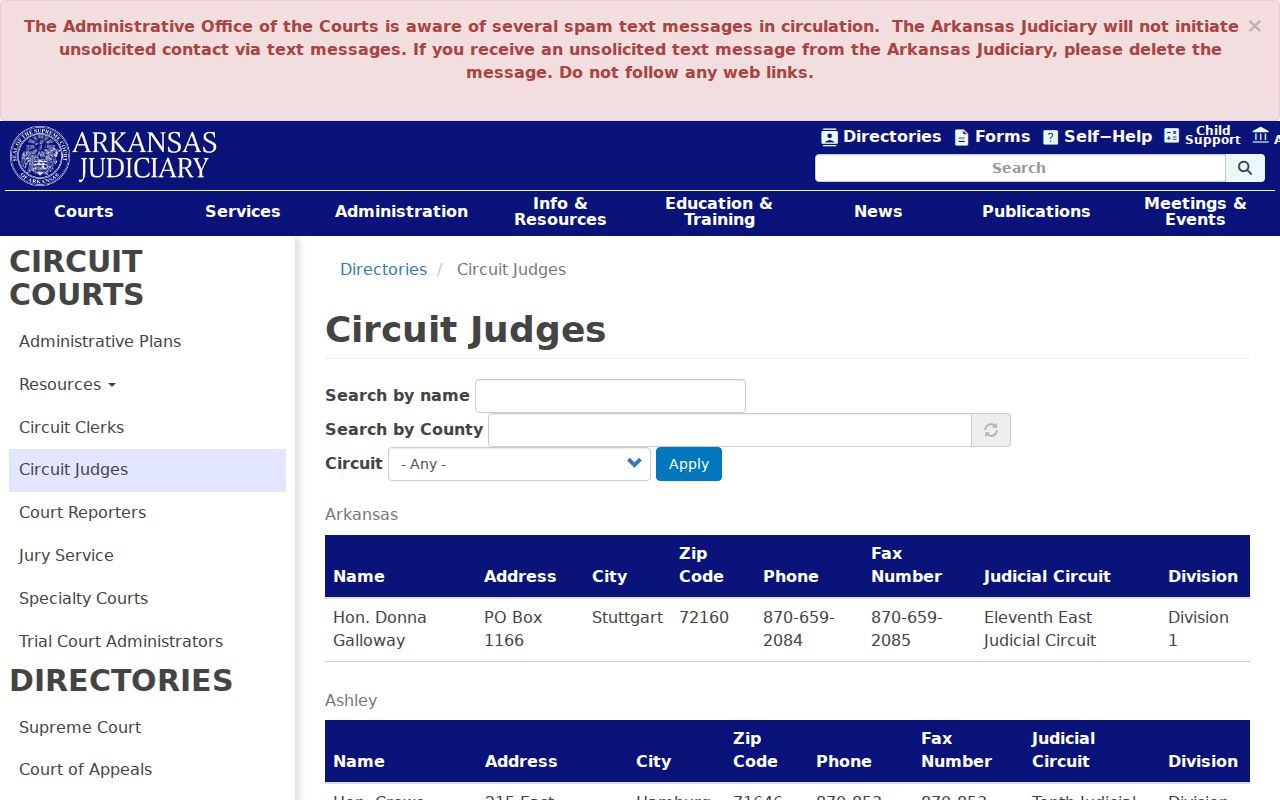
Treat the directory as a routing aid. The criminal docket and the clerk's file decide where a specific case is actually pending.
What a Criminal Docket Shows
A Miller County criminal docket can display several parts. Expect a case header, participants, Case Events, Offenses, Sentences, and a dated entry table. The portal numbers cases as the filing court assigned them. So skip any invented local pattern and copy the exact value from your notice. When the full identifier appears on screen, treat that court-assigned case number as controlling.
| Case Header | Case number, description, filing date, court, type, and broad status. |
|---|---|
| Participants | Public names, roles, and aliases entered by the filing court. |
| Offenses | Displayed charge description, count, classification, and related filing or disposition data. |
| Docket Entries | Filing Date, Description, Docket Detail, Name, and any public Documents link. |
| Settings and Outcome | Hearings, resets, orders, plea or trial events, disposition, sentence, and appeal notices when public. |
A blank sentence, bond, or document field means only one thing. The public view does not display that item. It says nothing about whether paper exists in the official Miller County criminal file.
Miller County Criminal Docket Outcomes
A charge entry is not a conviction. It records an accusation filed in court. The final outcome might be a guilty plea, a trial finding, dismissal, nolle prosequi, acquittal, diversion or deferred result, or some other disposition. Nolle prosequi means the prosecution was discontinued as the court record shows. A portal status like closed or disposed is too broad. It cannot tell you the exact result.
Read the final event carefully. Repeat the full disposition label displayed in the Miller County criminal docket, then obtain the signed judgment or sentencing order when exact legal wording matters.
That distinction matters when you track your own case or watch a public proceeding. A filed motion is not a granted motion either. Match each request with its later order, and match each old setting with any newer reset on the docket.
Stages on a Criminal Docket
The entry list traces the whole path of a Miller County prosecution. A felony may open with a complaint or preliminary event in District Court. An information from the prosecutor or a grand jury indictment then lands in Circuit Court. Arraignment records the plea and rights setting. Discovery, motions, bond events, notices, and continuances can pile up. They come before a plea or trial.
Docket flow: Filing › Arraignment › Pretrial › Plea or Trial › Disposition › Sentencing
Post-judgment motions and a notice of appeal can stretch the timeline further. Read entries by date. But note the future setting date inside an entry too. The newest filing is not always the next hearing.
Miller County Criminal Docket Terms
Miller County publishes no official code sheet for event labels. Write out full labels rather than guessing at abbreviations. These plain meanings separate entries that often sit close together:
- Continuance or reset
- A hearing or trial was moved; check for the new setting.
- Bond forfeiture
- An event alleging that the release-security obligation was breached, not the final case disposition.
- Capias or warrant
- Process directing custody; confirm current status with the court rather than relying on an old image.
- Disposition
- The stated way a charge ended.
- Sentencing
- The event at which sentence is imposed after a conviction.
Which Court Holds Criminal Dockets
The Miller County Circuit Clerk, 400 Laurel Street, Suite 109, Texarkana, keeps the Circuit Court criminal files. Call 870-774-4501 during the published weekday hours of 8:00 a.m. to 4:30 p.m., excluding holidays. That office handles felony files, inspection, paper retrieval, and plain or certified copies of court records.
District Court County Cases sits at 2300 East Street, reachable at 870-772-2780. City cases go through the District Court department at 100 N. State Line #2, which publishes 903-798-3016 and 903-798-3844 for criminal and ticket matters. State Line Avenue makes the Arkansas court identity critical, since Texarkana also reaches Texas courts. Use the court printed on your citation or notice.
Miller County Criminal Docket Divisions
Eighth South runs three Circuit divisions, and each circuit judge can hear Circuit matters. Assignment decides everything. Only the assigned office can confirm a setting, so never guess from the charge alone. Division 1 sits in Suite 207 at 400 Laurel Street and publishes 870-774-2421. Division 2 is in Suite 202 with 870-772-9618. The judiciary directory places Division 3 at the courthouse with 870-774-7722.
Check the criminal docket first, then call the assigned division for a current date. Call the Circuit Clerk for the filed record and copies. Those are separate tasks. Routing each question to the right office saves delay.
Missing Miller County Criminal Documents
Search ARCourts sometimes lists an event with no paper attached. That happens with older files, archived material, or items a deputy clerk must pull by hand. Write down the case number, the filing date, and the entry's description before you call the clerk. Ask what the Miller County criminal docket copy will cost. The court posts no set fee. Also ask how long retrieval takes. Decide whether you want a plain copy or a certified one.
No self-service terminal is guaranteed at the courthouse. Call ahead. A deeper lookup path is the Miller County case search. It helps you pin down the exact filing before making a request.
Note: a missing PDF never proves anything. The filing or the Miller County criminal docket may still exist.
Miller County Drug Court Dockets
Miller County and the Eighth South share an adult post-adjudication drug court. Arkansas treats it as a voluntary program built in phases. Phases bring court appearances, supervision, treatment, testing, and team review. The filings stay under the underlying criminal case number. There is no separate public treatment docket.
SCALES keeps referral, assessment, testing, treatment, supervision, and progress data away from the public case-information events. Do not expect those clinical records inside Search ARCourts. Division 1 can explain current public program routing. Requests should never seek private participant data.
Miller County Criminal Docket Resets
Old settings linger in the event history even after a case moves on. Start with the newest setting entry. Then read every later event for a continuance, reset, cancellation, disposition, or signed order. Note that a filing date and a hearing date serve different purposes. Compare them before assuming anything.
When the portal and a paper notice disagree, call the assigned division. Search ARCourts can lag behind a signed change or an emergency closure. The Circuit Clerk helps you identify the file. The judge's office holds the working calendar.
Miller County Criminal Docket Access
The full access chain runs in order: online search, a call to the correct clerk, the clerk's counter for inspection or copies, a narrow written request, archival retrieval when needed, and the assigned division for a current court date. Search ARCourts stays free. It needs no public login at its landing search. Arkansas eFlex exists for authorized filing. It is not a public docket substitute.
A mailed request should name the court, the case number, the event date, and the paper you want. Include your delivery choice. Say whether certification is required. The Miller County transparency contact can route general county public-record questions. Still, the Circuit, County, and District clerks hold the judicial files themselves.
Public Access and Sealed Criminal Dockets
Court-record access and its exclusions fall under Arkansas Supreme Court Administrative Order No. 19. The Arkansas Freedom of Information Act, Ark. Code Ann. § 25-19-101 et seq., cannot override judiciary rules or a sealing order. Juvenile confidentiality under Ark. Code Ann. § 9-27-309 and the Comprehensive Criminal Record Sealing Act, Ark. Code Ann. § 16-90-1401 et seq., can each limit what a public Miller County criminal docket shows.
Key rules:
Administrative Order No. 19 controls public court-record access, exclusions, and compiled data.
Arkansas juvenile and sealing laws can close or suppress criminal case information that otherwise might be public.
Miller County's transparency channel does not replace the clerk's process for a judicial case file.
When a known case is absent, check the spelling, year, court, county, state, and case number first. Then ask the correct clerk. A public omission can mean the wrong court, a record not yet migrated, an archived file, or a lawful restriction.